Blocks
- TODO
Gadgets/Contraptions
This system is going to be essential to get right. If it’s too simplistic, then the entire “build your own contraption” idea is just window dressing on what should have been a basic item catalog. If it’s too complex, then - well, it still should have been just items. Players will bounce off or burn out.
Much thought is required as to how exactly a gadget is going to influence a level, or the world. In fact, we might be well served to design the entire game around the things we can think of contraptions doing, rather than vice versa, as the rest of the game - sokoban, wario(+ware)like, dungeon delver (arguably) - is pretty solidly defined, and we could make a decent game with just those pieces of it.
Inputs and Outputs, Size and Speed
If I understand correctly, one of the defining features of a Zach-like system is the idea of inputs and outputs. The program operates on the inputs to produce the outputs, and that’s the game. Many Zachlikes also care about the size of your program (because it’s like a microchip, or a chemistry set, and smaller is usually better and more efficient) and the speed of your program. You’re ranked on these things, but usually aren’t punished for ignoring them.
In our game, however, we add to this an outside world - the heist environment - which can be affected by your gadgets’ outputs. Imagining something like an oil slick, or a banana peeler, easily lets us think of a situation where more is better: more oil, or bananas, is slipperier than less. I believe that since our game’s runs are timed, then the speed of a gadget’s solution should impact this “rate of fire”. Likewise, the mice are carrying these things around. Logically, the smaller a contraption is, the easier it is to carry. So we have a way to make the size of a gadget benefit or harm the player as well.
But what else can a gadget do, other than the trivial example of slicking a tile?
- Gadgets could ingest a player resource like cash, or stamina, or HP.
- They could deplete per-mission pools of pickups you get around the level, like for example 4 buckets of Scrap, Junk, Flotsam, and Jetsam. (Might detract from game theme to encourage farming?)
- They could eat from a pre purchased list of goods in your inventory, like buy Flour and Yeast beforehand if you are going to be making Bread in mission. (Plays well w the idea of smaller = better, if resources compete for inv space w gadgets themselves)
- this one’s weird: they could ingest THINGS IN THE LEVEL.
- A Trap could eat an Enemy and produce a Caged Enemy.
- A Drill could eat Walls and produce Sawdust.
List of possible Outputs
- Oil
- Banana peel
- Fire
- Water
- Ice
- Slime
- Meat
Crafting
Should crafting have programmed object transformations?
Contrast:
- Satisfactory crafts things if you can just get them into the machine.
- Opus Magnum makes you rotate and join and convert the things as part of the game of making the things. It seems that for our purposes we want to use a Satisfactory model, because the programming of rotations and so on is a lot of teaching overhead, and since this is just a subsystem of the game, we want it to be a little simpler.
How are crafting solutions ranked?
The crafting process should have at least 2 scorable aspects:
- Size and/or Weight
- A smaller/lighter crafting recipe solution permits you to carry more of it with you, ie increases your stack size.
- Efficiency (either Speed or Resources)
- A faster solution gives you more power per use, e.g. more pellets in the shotgun shell, or a slipperier banana peel.
- A more resource-savvy solution lets you make more outputs per unit input, but it requires us to stipulate that resources are consumed when crafting.
Should crafting consume resources?
In order to craft with scarce resources, the player would need to grind for them. I don’t think grinding for crafting resources will improve any parts of the game, so maybe they can “discover” ingredients once (say, the first time they encounter a particular block or tile) and then use them ad libitum in future recipes.
If we opt for limitless resources, then balancing carry limits will be more important. Also, we lose the excitement of players committing their precious nonrenewable contraptions to a strat. A different cost may need to be imposed.
How do players find new recipes?
Compare: researching new technologies in Satisfactory.
The fun (for recipes specifically) will be in
- discovering recipes by randomly placing items, if you can use recipes at any time
- pro: discovery is not gated by game progress.
- pro: rewards experimentation
- pro: players can share recipes to get an edge
- con: discovery CANNOT be used to gate game progress, because we don’t know what recipes they have at a given level… unless we award them critical recipes anyway.
- unlocking recipes by ??? (presumably doing new puzzles)
What are verbs?
We just don’t know.
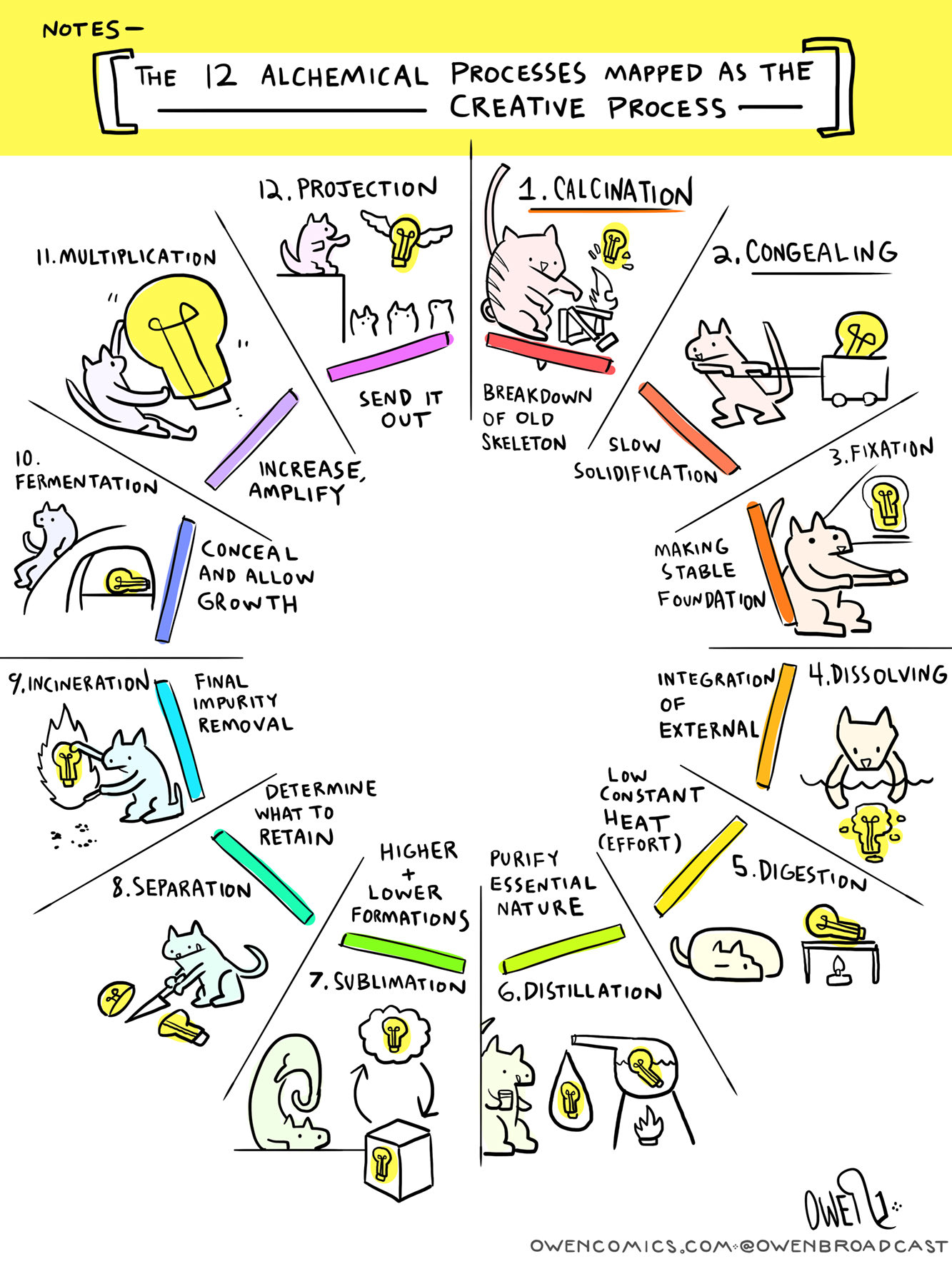
Possible reference inspiration: the 12 alchemical processes.
Verbs in Opus Magnum
- join 2 groups of 1 or more things
- split 2 groups of 1 or more things
- convert thing A to thing B by spending thing C
- convert thing A into things B, C, D, and E
Example recipes
- Make a stick from splinters.
- Make a torch from a stick and butter.
- Make a cage from sticks.
- Make a banana peel from a banana, or a peel pile from several.
- Make a cheese wheel from chunks of cheese.
Example verbs in use
- Tie splinters with string to make a stick.
- Dip a rag in butter, and tie it with string to a stick (or just roll it around the stick) to make a torch.
- Or: just shmush butter on a stick.
- Shmush two sticks to make a pole.
- Shmush a bunch of sticks to make a cage.
- Unwrap a banana to make a peel.
- Roll cheese to make a cheese wheel. If we assume Satisfactorial operation styles - that is, the verbs simply perform the action, and the artfulness of the recipe is “somewhere else” - how can we let players make unique solutions for these recipes?
If we assume Opus Magnum styles - that is, you have to use instructions to get the ingredients in place for the verbs - how do we keep the art simple enough to learn in the middle of playing an action sokoban?
Tetromino Crafting
- The recipe is a possibly contiguous shape of cells on a grid.
- Ingredients are tetrominos.
- Fill the recipe with ingredients to craft an item.
Pros
- Simple
- Versatile
- Expressive
- Extensible
- Unique
- Pieces can have Weight for an easy metric of goodness
Cons
- Hard to gauge efficiency (is fewer pieces better?)
- Speed is either more punishing or trivial if you can memorize it
- Not a lot of urgency
Handslop Crafting
The idea is your “hands” are WASD+arrows or LS+RS, and they shake a lot, and you have to just touch the items together.
Summary of conversation with X. X raises the criticism that we are not actually diegetically building a machine to produce more machines, which is what Satisfactory, Opus Magnum, etc. are about. We are one guy in a basement, and we are making one contraption. It is still possible to design a process from this, though. But we need to drastically alter the aesthetic from assembling a factory, or rather designing an assembly line. We need to change it to something more like hand slop. You have a maximum of two held items. Let’s take, for example, a stick and some butter. On your crafting bench, you literally see your mousy hands holding a stick and a chunk of butter. Your left hand is your left stick, and your right hand is your right stick. When you’re not pressing a stick, you randomly rotate them this way and that, and move them. But if you’re pressing the stick, then it will move in that direction. Your goal is just to smush the stick into the butter. We monitor how much area is covered by the moving items, and we monitor how much time it takes you to assemble. We use those two metrics to determine the efficiency and the area of your solution. If you’re a multi-step assembly, then when you’re done creating your torch, you free up a hand holding your torch in the other hand, and you have to grab the pepper out of your pouch and put the pepper onto the torch to make a spicy torch. The process of assembly is organic, natural, not shoehorned in from a different game, and we have a sensible way of measuring how it works.
Pros
- Even simpler
- Fit the mood of scrambling
Cons
- Not really zachlike
- Not super extensible as you are always just handholding items together
Yapping
I agree that once you play the minigame once for a recipe, you should be able to just make more at that level of excellence without playing it again. As stated in my doc, resources shouldn’t be limited because grinding is not part of the aesthetic. In-mission, I think you can select 3 contraptions to bring, and you get to bring your max stack of each - stack size is determined by your performance in the crafting minigame. During a mission, you can use that many contraptions. Then, how about this - you can find materials during a mission by touching blocks - splinters from boxes, butter from butter blocks - and then if you run out of items during the run, you can re-enter the minigame to craft more, 1 per attempt. So there’s a duality to it which re-emphasizes the core feeling of desperate artifice. … As for starting coding on this, the game isn’t ready for much of it - there’s no “base” yet, as the prototype just throws you into the only mission of 5 levels that I’ve made so far. So if you do want to help, I think we can make the most progress working on a systems level. Unlocking resource types, measuring speed and area efficiency during crafting, tracking discovered ingredients during a mission - even the mission system in general, really. I’ll probably end up designing a ton of levels even though I actually want to do procgen; it’s just really tough to procgen something with so many custom/zany mechanics compared to a regular sokoban (imagine trying to make a puzzle where placing a banana was required - next to impossible to code the generator for something that path dependent). A mission, in case it’s not clear, is a run of N levels, and after you finish the run you have to go back through the levels you’ve just done to escape. Ideally, the levels will be “the way you left them”. Right now, they’re just separate scenes, so any modifications are lost on reinstantiation.